By Candra · Licensed Medical Micropigmentologist & PMU Instructor ·
About the author
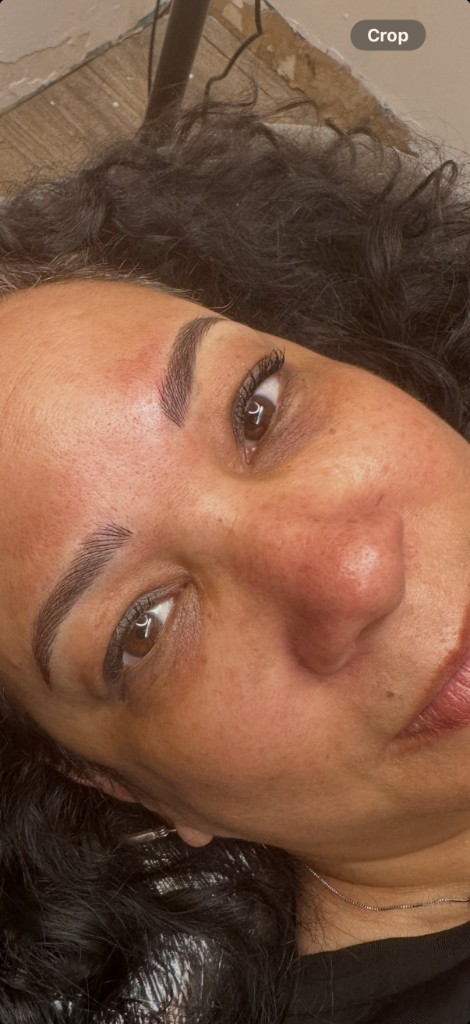
Candra is a Licensed Medical Micropigmentologist and PMU Instructor at Shaded & Bladed in Tulsa, OK. She addresses this comparison at nearly every consultation with clients who have never had either procedure.
Permanent makeup and regular tattoos share a basic mechanism: pigment is deposited into the skin using a needle. That is where the similarities largely end. Depth, ink composition, longevity, machine type, and how the work ages are all meaningfully different between the two. At Shaded & Bladed in Tulsa, Candra — a Licensed Medical Micropigmentologist at 8026 S Memorial Dr — addresses this comparison at nearly every consultation. The clients who understand the difference are the ones who move forward confidently; the ones who conflate PMU with traditional tattooing often hold back from something that would have served them well.
Depth — the most fundamental difference
The most important technical difference between permanent makeup and a traditional tattoo is the depth at which pigment is deposited.
**Permanent makeup targets the superficial dermis** — the upper layer of the dermis, just below the epidermis. This is a relatively shallow placement that takes advantage of how the skin holds pigment long-term in a stable layer without going so deep that the pigment becomes permanent in the true sense.
**Traditional tattoos target the deeper dermis** — significantly deeper than PMU. This depth is why tattoo ink stays visible for decades without significant fading and why it cannot be fully removed with saline. The ink is placed where cell turnover barely touches it.
The depth difference explains almost everything else: why PMU needs a touch-up every 1–3 years (the superficial dermis cycles), why it is removable, why the procedure is less painful, and why the healing time is shorter.
Ink composition — iron oxide vs. carbon
The pigments used in permanent makeup and traditional tattoos are chemically different.
**PMU pigments:** Made primarily from iron oxide compounds. Iron oxides are stable, skin-safe minerals that produce natural-looking colors — warm browns, soft blacks, dusty pinks — that sit well in the skin without the neon or saturated hues associated with traditional tattoo ink. Iron oxide pigments are specifically formulated to behave well in the superficial dermis and to fade gracefully over time.
**Traditional tattoo inks:** Primarily carbon-based (for black and dark colors) or synthetic organic pigments (for colors). Carbon ink is extraordinarily stable — it does not break down the way iron oxide does, which is why traditional tattoos remain vibrant for decades. Color tattoo inks use synthetic pigments that can be vivid and saturated in ways iron oxide-based PMU pigments are not.
The composition difference also explains how each ages: PMU pigment fades from rich to soft as the iron oxide breaks down. Traditional tattoo ink does not fade the same way — it may oxidize (carbon black can shift slightly blue-green over decades) but it does not lighten to a trace the way PMU does.
Longevity — touch-ups every 1–3 years vs. decades
**Permanent makeup at Shaded & Bladed needs a touch-up every 1–3 years** for nano brows, powder brows, and lip blushing. Without a color boost in that window, the pigment fades to a very faint trace. Annual color boosts at $200 extend the results indefinitely.
**Traditional tattoos are designed to last a lifetime** — decades without significant fading, though the colors may shift over time. A black tattoo on the arm at 25 is still dark and legible at 55.
The longevity difference exists because of the depth and ink composition differences described above. PMU's shallower placement in the cycling superficial dermis means the pigment naturally migrates out over time. A traditional tattoo's deeper placement means the ink stays put.
For most clients, needing a PMU touch-up every 1–3 years is a feature, not a bug. Faces change over time — brow shape trends, age-related skin changes, personal style shifts. PMU results that refresh or adjust every few years are more flexible than permanent designs that are truly forever.
Machine and technique — digital PMU machine vs. tattoo gun
**PMU is done with a digital PMU machine** — a device designed specifically for cosmetic pigment work. It uses a single ultra-fine nano needle (for nano brows) or a specialized cartridge that moves with precision and consistency. The machine regulates depth and speed mechanically, which allows for the controlled, shallow placement that PMU requires. The motion is rapid and light — many clients describe it as a vibration or tapping rather than a cutting sensation.
**Traditional tattoos use a rotary or coil tattoo gun** — a machine designed to drive needles deeper and faster for more permanent placement. Tattoo guns are built to work at the depth and speed needed for decades-lasting results in the deeper dermis. The needle motion is different — more aggressive penetration for deeper placement.
The machine difference is one reason PMU hurts less than traditional tattooing in most clients' experience. Shallower placement with a lighter-touch machine, combined with 20–30 minutes of topical numbing standard at every Shaded & Bladed session, means most clients experience PMU as mild pressure rather than pain.
How each ages — fading vs. oxidation
**PMU ages by fading:** The pigment lightens gradually over the 1–3 years between touch-ups, often shifting slightly warmer in tone as the cooler components break down first. Well-done PMU by a skilled artist like Candra ages gracefully — going from vivid and defined to soft and natural before eventually becoming nearly undetectable without a refresh.
**Traditional tattoos age by oxidation:** Carbon black ink does not disappear — it may shift slightly toward blue-green tones over decades as the carbon particles change. Color tattoos may yellow or lose vibrancy. Traditional tattoos do not fade to a trace — they remain present but aged.
For face and lip work specifically, the PMU aging pattern is significantly preferable. A tattoo that does not fade is a tattoo whose design is fixed permanently on your face regardless of how your features, preferences, or skin change over decades. PMU's natural fading and adjustability make it a much more appropriate medium for cosmetic facial work.
For questions about any of these differences or to schedule a free consultation, call (918) 940-2888. Shaded & Bladed is at 8026 S Memorial Dr, Tulsa, OK 74133. Services start at $400 for nano brows, powder brows, and lip blushing — with the 6–8 week touch-up included.
Results vary by individual. Consult a licensed permanent makeup artist for a personalized assessment before booking.
Frequently asked questions
Shaded & Bladed · 8026 S Memorial Dr, Tulsa, OK 74133 · (918) 940-2888