By Candra · Licensed Medical Micropigmentologist & PMU Instructor ·
About the author
Candra is a Licensed Medical Micropigmentologist and PMU Instructor at Shaded & Bladed in Tulsa, OK. She has extensive experience adapting PMU technique for mature skin clients.
Permanent makeup for mature skin is one of the most impactful services Shaded & Bladed offers — and one that requires the most nuanced technique. Skin changes significantly after 50: it becomes thinner, loses elasticity, produces less sebum, and may show the effects of decades of sun exposure. These changes do not make permanent makeup less suitable — they make technique more important. Candra, a Licensed Medical Micropigmentologist at 8026 S Memorial Dr in Tulsa, adapts her approach for mature skin clients at every appointment.
How skin changes after 50 affect permanent makeup
**Thinner skin.** After menopause, collagen production decreases significantly. The dermis — the layer where PMU pigment is deposited — becomes thinner. This means the needle passes to depth more easily, and consistent pressure control matters more to avoid oversaturation. The digital PMU machine Candra uses at Shaded & Bladed allows precise depth and speed control — an advantage over manual blade techniques on thinner skin.
**Oily-to-dry shift.** Younger oily skin is a challenge for hair-stroke techniques (strokes can blur). Mature skin is typically drier, which changes the retention picture. Dry mature skin can actually hold pigment well — but the skin's reduced cell-turnover rate also means the natural correction mechanism for uneven pigment is slower.
**Sun damage and texture.** Years of Oklahoma sun exposure — UV index 9–11 from May through September in the Tulsa area — affects skin texture. Uneven texture means uneven pigment uptake. Areas with sun damage may retain pigment differently than undamaged areas, requiring attention during the procedure and potentially additional pigment work at the touch-up.
**Sparse brows from over-tweezing.** Many clients over 50 over-tweezed in the 1980s and 1990s when thin arched brows were fashionable. Repeated removal of follicles over many years can permanently reduce brow density. Permanent makeup creates the appearance of full brows regardless of how much natural hair remains.
Why powder brows often outperform nano brows on mature skin
Nano brows use individual hair-stroke patterns deposited with an ultra-fine needle. On thinner, more textured mature skin, these strokes can spread slightly at the edges as the skin heals — reducing the crispness of individual strokes. The same mechanism that affects oily skin (strokes blurring at edges) applies on very thin or textured skin, though for different reasons.
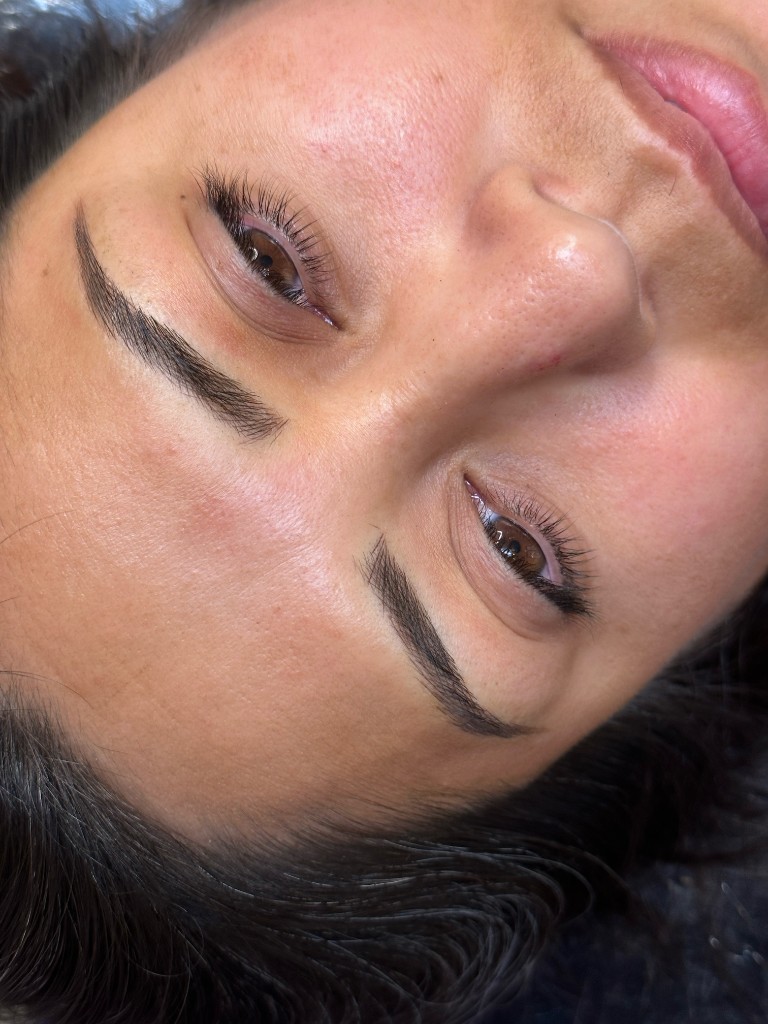
Powder brows use a shading pattern that deposits pigment more evenly across the brow area. On mature skin, the airbrushed shading fades more evenly and requires fewer touch-up sessions to maintain a consistent look. The result also tends to look more naturally filled-in on brows where hair density is low.
This is not a universal rule — some mature-skin clients are excellent candidates for nano brows. Candra assesses your specific skin at your free consultation and recommends the right technique honestly, based on what will actually produce the best result for your skin.
Pigment selection for mature skin
Pigment color selection matters more on mature skin for two reasons: the color heals differently and the skin's undertone may have shifted.
Cooler or ashier pigments can look gray or flat on mature skin, especially where redness or uneven undertone is present. Warmer-based pigments tend to heal more naturally on skin that has accumulated sun damage or changed undertone over decades.
For brows, lighter, warmer browns that match current hair color (which often lightens with age) produce the most natural healed result. A pigment that reads as a perfect match on younger skin may appear too dark or too cool on mature skin.
Candra color-matches at the consultation and makes adjustments for mature skin. This is part of the free consultation process — bring no makeup or arrive with minimal brow product so the consultation is based on your real skin.
What to expect from healing on mature skin
Healing on mature skin typically takes slightly longer than on younger skin. Cell turnover is slower, which means the ghost phase (days 10–21) may be more pronounced and the true healed result may not be fully visible until 6–7 weeks rather than 4–5 weeks.
The touch-up appointment at 6–8 weeks is especially important for mature skin clients. Because retention can be less predictable on thin or textured skin, the touch-up fills any areas where pigment did not take as expected and refines the result to the intended density.
Contact Shaded & Bladed at (918) 940-2888 or visit our studio at 8026 S Memorial Dr, Tulsa, OK 74133 to schedule your free consultation. Candra will give you an honest assessment of which technique is right for your skin at your current stage.
Results vary by individual. Consult a licensed permanent makeup artist for a personalized assessment before booking.
Learn more
Frequently asked questions
Shaded & Bladed · 8026 S Memorial Dr, Tulsa, OK 74133 · (918) 940-2888